Key Takeaways
- Most organizations operate a hybrid records estate, physical and electronic simultaneously, and their software needs to reflect that reality rather than paper it over.
- Electronic RMS governs content, metadata, and disposition; physical RMS governs containers, custody, and location. They solve different problems and neither substitutes for the other.
- A single retention schedule applied consistently across media types is the foundation of defensible compliance. Two parallel schedules that drift apart create audit risk.
- Cross-media legal hold, where a hold triggered on an electronic record automatically flags the corresponding physical container, is a capability most siloed environments lack.
- The software decision starts with a media audit of your active retention schedules, not a feature comparison between vendors.
The “go paperless” mandate is roughly two decades old, and most organizations have made real progress. But physical records haven’t disappeared. They persist in file rooms, off-site vaults, and inherited archives across virtually every regulated industry, sitting alongside born-digital records that live in cloud repositories, ECM platforms, and email archives.
The question isn’t paper versus digital. It’s whether your software can govern whichever media your records actually live on. An organization that manages its electronic records well but has no systematic tracking for its physical inventory has a governance problem, and that problem shows up in audits, litigation holds, and destruction authorizations.
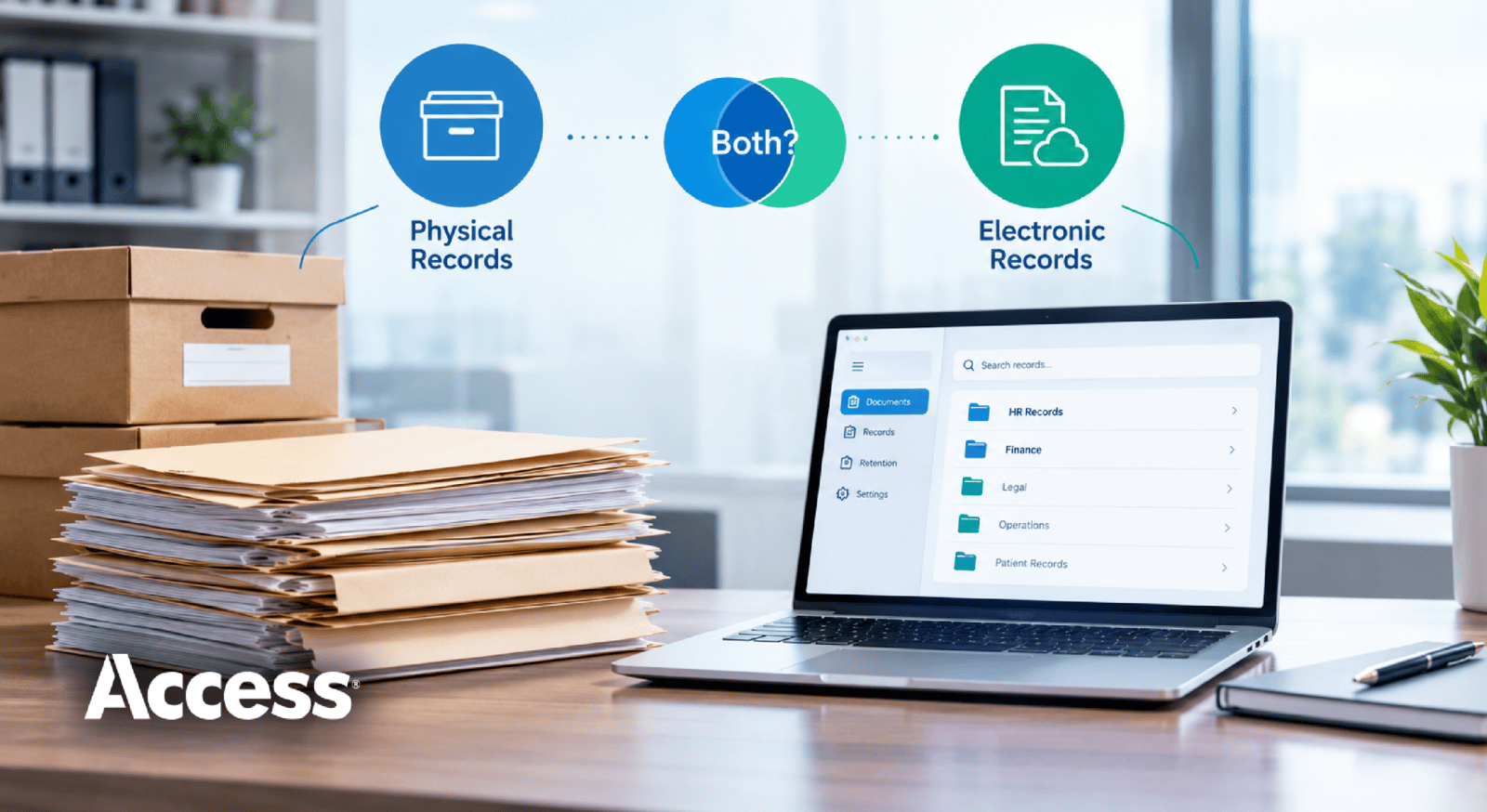
This article lays out what each category of records management software does, why physical records remain a fixture in most regulated environments, and how to decide whether you need one system, the other, or both.
What each type of records management software does
Understanding the software decision starts with understanding what each system is built to manage.
Electronic records management software
“Electronic records management software,” or ERMS, governs born-digital and digitized records. Its core functions include metadata capture, version control, access permissions, retention scheduling, legal hold, and audit trails. A well-configured ERMS enforces disposition automatically: records that have met their retention period and cleared any active holds are flagged for deletion or transfer without manual intervention.
ERMS platforms typically integrate with ECM systems, ERP platforms, email archives, and cloud storage repositories. Records don’t live in the ERMS itself so much as the ERMS applies governance rules to records wherever they reside. The record management system overview on the Access blog covers the foundational concepts if you need a reference point.
Physical records management software
“Physical records management software,” or PRMS, tracks boxes, folders, and media items by barcode or RFID across storage locations, including on-site rooms, off-site facilities, and secure vaults. It manages chain of custody, retrieval requests, destruction authorizations, and space and cost reporting.
A PRMS does not manage the content of a document. It manages the container and its location. That distinction matters: a PRMS can tell you that Box 4471 is in Bay 12 of a third-party storage facility and was last retrieved on a specific date. It cannot tell you what’s inside the box unless someone has catalogued the contents separately.
Access Classic Records Management is built for organizations managing physical-first or legacy estates, covering the custody, retrieval, and destruction workflows that a purely electronic system can’t address.
Why physical records haven’t disappeared
The persistence of physical records isn’t a failure of digital transformation. It reflects several durable realities.
Wet-ink signatures, original wills, property deeds, and certain regulated instruments still require paper originals in many jurisdictions. No amount of scanning changes that legal status. In FDA-regulated environments, 21 CFR Part 11 sets specific conditions under which electronic records can substitute for paper originals, and those conditions aren’t always met.
Some agencies specify retention of paper originals for defined periods regardless of whether a digital copy exists. Healthcare organizations navigating healthcare records management requirements routinely hold both scanned images in an ERMS and original signed consent forms or films tracked in a PRMS, both under the same retention schedule.
Decades of pre-digital records exist that haven’t been converted and, in many cases, won’t be. The cost-benefit math doesn’t always favor scanning: low-retrieval, long-retention boxes are often cheaper to store than to digitize, particularly when retrieval frequency is measured in years rather than weeks.
Mergers, acquisitions, and decentralized operations also create inherited physical estates. An organization mid-way through digital transformation may be fully digital for records created after a certain date and entirely physical for everything before it.
The hybrid reality: why most enterprises need both
A “hybrid records estate” is an organization that holds records in both physical and electronic form simultaneously, often under the same retention schedule. This isn’t an edge case. It’s the default condition for most regulated industries, including healthcare, legal, financial services, and government, and for any organization that has gone through a merger, acquisition, or partial digitization effort.
The governance problem in a hybrid estate is straightforward: using only an ERMS leaves your physical inventory invisible to your governance program. Using only a PRMS leaves your digital records ungoverned. Either way, you have records that exist outside your retention schedule enforcement.
Compliance officers need a single retention schedule applied consistently regardless of media. ARMA International’s Generally Accepted Recordkeeping Principles require completeness and integrity of records across the full records estate, not just the portion that happens to be digital. Siloed systems make that consistency difficult to demonstrate and even harder to audit.
Consider a practical example. A healthcare organization holds patient records as scanned images in an ERMS and as original films or signed consent forms tracked in a PRMS. Both sets of records are subject to the same retention rule. If a legal hold is triggered, it needs to apply to both. If the ERMS and PRMS aren’t connected, someone has to manually identify and flag the physical counterparts, and that manual step is where holds get missed.
Access Unify Records addresses this directly as a platform that spans physical and electronic governance, applying a single policy engine across media types rather than running parallel systems that drift. The broader Access Unify platform is worth reviewing if your organization is evaluating how physical and electronic governance fit into a larger information management architecture.
Legacy EHR Archive Readiness Workbook
Your Workbook Is Ready Start with a real request your team may need to fulfill, such as an audit, release-of-information request, legal review, or financial follow-up. Work through the 15 questions with the people responsible for the archive and score…
When you can operate with one system
There are legitimate scenarios where a single system is sufficient.
Electronic-only scenarios
An organization that is fully born-digital, holds no legacy physical estate, and operates in a regulatory environment that accepts electronic records as authoritative can reasonably run on an ERMS alone. All records must be in scope for the ERMS’s retention and disposition rules, and there must be no legal original requirements that mandate paper.
Physical-only scenarios
Physical-only is rare and shrinking. It applies to very small organizations with a minimal digital footprint, niche archival or collections contexts where digital records are negligible, or an interim state during a system migration. For most organizations, this is a temporary condition rather than a stable operating model.
The practical test
Audit your active retention schedules. How many series include physical media? If the answer is more than a handful, a PRMS or a unified platform is likely required. Ask a second question: can your current software produce a defensible chain-of-custody report for a box retrieved from off-site storage? If it can’t, you have an exposure that your next audit or discovery request will surface.
What to look for in a unified or integrated approach
Whether you’re evaluating a unified platform or planning to integrate separate systems, several capabilities are non-negotiable for a hybrid estate.
One policy applied across media types is the foundation. Two parallel schedules maintained by different teams will drift, and the discrepancy will matter when a regulator asks why a physical record was destroyed before its electronic counterpart’s retention period expired.
A hold triggered in the ERMS should automatically flag corresponding physical containers. Manual coordination between systems is a process risk, not a control.
Electronic request, physical fulfillment, and digital delivery, including scan-on-demand through scanning and imaging workflows, should be tracked end-to-end in a single system of record.
Both electronic deletion and physical shredding should require the same approval chain and produce a certificate of destruction. Separate authorization processes for separate media types create inconsistency in your defensibility posture.
Regulators and auditors expect a coherent view of your records estate. Patchwork spreadsheets and disconnected system logs don’t satisfy discovery requests or demonstrate program maturity.
Making the software decision: a practical framework
Start with your records, not the software.
- Step one is a media audit. Quantify your active physical versus electronic record series. This is the baseline. Without it, any software decision is speculative.
- Step two is regulatory mapping. Identify which series require paper originals or carry media-specific retention rules. These series drive your PRMS requirements regardless of your digitization ambitions.
- Step three is retrieval frequency analysis. High-retrieval physical records justify tighter PRMS integration and potentially scan-on-demand workflows. Low-retrieval records may need only basic location tracking.
- Step four is integration requirements. Map the ECM, ERP, and cloud systems your ERMS must connect to. Integration complexity often determines whether a unified platform is more practical than integrating separate systems.
- Step five is governance model. A centralized information governance team typically favors a unified platform with a single policy engine. A federated model across business units may require strong API integration between separate systems, with clear ownership of the integration layer.
Conclusion
The question isn’t electronic versus physical. It’s whether your software governance covers every record regardless of where it lives. For most regulated organizations, that means both an ERMS and a PRMS, or a unified platform that handles both, because the records estate is hybrid by default.
Start with a media audit. Map your retention schedules to media types. Identify where your current software leaves physical records invisible or digital records ungoverned.
FAQs
Can we apply a single retention schedule across both physical and electronic records, or do we need separate schedules for each media type?
One schedule is the goal, and it’s achievable. The retention obligation attaches to the record series, not the medium. A patient consent form has the same retention requirement whether it’s a scanned image in an ERMS or a paper original in a physical vault. The operational challenge is enforcement: if your ERMS and PRMS run independently, the schedule exists in two places and diverges over time as teams update one but not the other. A unified policy engine, such as the one in Access Unify Records, applies a single schedule to both media types, which is the only way to maintain consistency at scale without manual reconciliation.
How does legal hold work when the same record series exists in both physical and electronic form?
In a siloed environment, it doesn’t work reliably. A hold triggered in the ERMS suspends electronic disposition, but unless someone manually identifies and flags the corresponding physical containers in the PRMS, those boxes remain on their normal destruction schedule. That’s a litigation risk. Cross-media legal hold, where a hold event in one system automatically propagates to the other, is the correct control. If your current systems don’t support it natively, document your manual process in detail and test it. Auditors and opposing counsel will ask how you ensured completeness.
We’re mid-digitization. Do we need a PRMS for the physical records we haven’t converted yet, or can we manage them in a spreadsheet until the project is done?
Spreadsheets are not a records management system. They don’t enforce retention, don’t produce a defensible chain-of-custody log, and don’t integrate with legal hold workflows. If your digitization project spans more than a few months, and most do, you’re operating a hybrid estate in the interim, and that estate needs governed software. Access Classic Records Management is designed for exactly this scenario: organizations that need systematic physical tracking during and after a digitization effort, without waiting for the project to complete before establishing governance controls.
What’s the realistic cost-benefit threshold for deciding whether to scan legacy physical records or continue storing them?
The calculation depends on retrieval frequency, regulatory requirements, and storage costs. High-retrieval records with active business use justify digitization because scan-on-demand delays add friction and cost. Low-retrieval, long-retention records, boxes accessed once every several years, are often cheaper to store in a managed facility than to scan, index, and migrate into an ERMS. The break-even point shifts when a regulatory mandate requires paper originals regardless of digitization, in which case scanning produces a convenience copy but doesn’t eliminate the physical storage obligation. Run the analysis per record series, not across the entire estate as a single decision.
How do we handle destruction authorization when physical and electronic records are governed by separate systems?
Separate authorization chains for separate media types create inconsistency that is difficult to defend. The standard to aim for is a single destruction authorization workflow that covers both the electronic deletion and the physical shredding of a record series, producing a unified certificate of destruction. If your systems are separate, the minimum control is a documented, mandatory cross-check: no physical destruction order is issued without confirming the electronic counterpart’s disposition status, and vice versa. Anything less creates the possibility of destroying one copy while the other remains active, or retaining both past their authorized period.
Our physical records are stored at a third-party facility. Does the software decision change when custody is outsourced?
The governance obligation doesn’t change. Your organization is still responsible for the retention schedule, legal holds, and destruction authorization regardless of who holds the boxes. What changes is the integration requirement. Your PRMS needs to communicate with the facility’s inventory system so that retrieval requests, hold flags, and destruction authorizations flow without manual re-entry. Access manages both the software and the physical storage infrastructure for many clients, which simplifies that integration considerably compared to connecting a standalone PRMS to an unaffiliated third-party facility.
When evaluating a unified platform versus integrating separate ERMS and PRMS products, what’s the deciding factor?
The deciding factor is usually the complexity of your policy environment, not the feature list. If your retention schedules are straightforward and your physical and electronic estates are relatively stable, a well-integrated pair of best-of-breed systems can work. If you have complex, cross-media retention rules, frequent legal holds that span both media types, or a centralized governance team responsible for the full estate, a unified platform with a single policy engine is materially easier to operate and audit. Integration between separate systems requires someone to own the integration layer, test it after every upgrade, and reconcile discrepancies. That operational overhead compounds over time. The Access Unify platform is worth evaluating if your governance model is centralized and your estate is genuinely hybrid.
How do we demonstrate to auditors that our physical records are under the same governance program as our electronic records?
The evidence auditors look for is a single retention schedule that explicitly covers physical media, documented chain-of-custody logs for physical containers, destruction certificates that match your authorized retention periods, and legal hold records that show physical records were identified and suspended alongside electronic ones. If those records live in disconnected systems, you’ll spend significant time assembling the evidence manually for each audit. A unified audit trail that spans both media types, showing policy application, retrieval history, hold events, and disposition actions in one report, is the most efficient way to satisfy that scrutiny and demonstrate program maturity.
Related Reading
See how unified records governance works in practice
If you’re working through the decision of whether electronic, physical, or a unified approach fits your records estate, a walkthrough is a practical next step. Request a demo and we’ll walk through your specific environment, retention schedules, and governance requirements together.

Share