Before you shut down a legacy EHR, test the archive the way your team will use it after decommissioning. Can authorized users find the right record, confirm it is complete, and show how it was retrieved and produced? Use the…

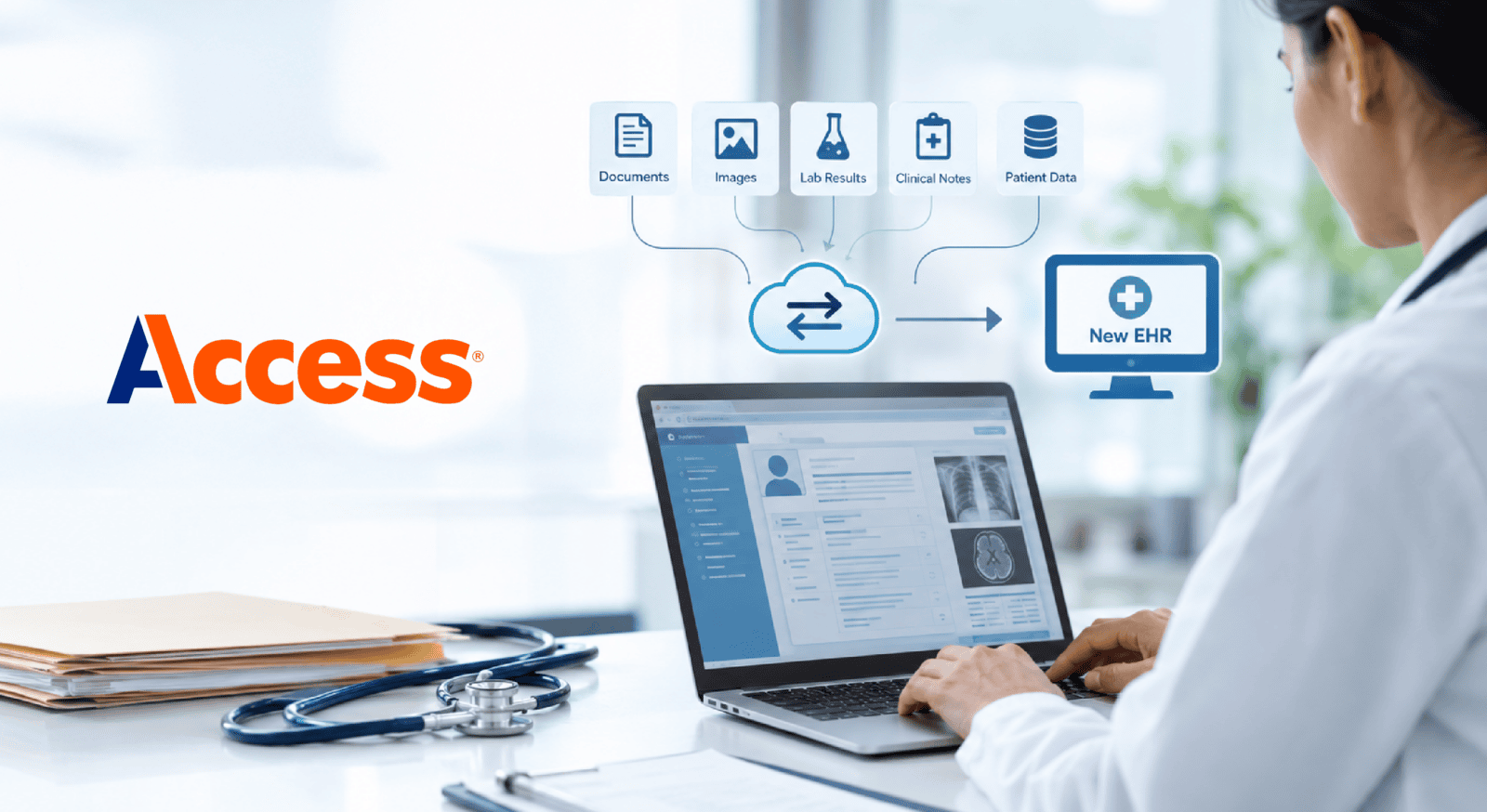
Healthcare organizations traded manila patient folders for digital files years ago. According to recent research from Deloitte, though, 60% of them are still operating on legacy EHR systems designed for physical records.
Many times, organizations linger on outdated systems because data migrations between EHR systems are among the most complex and difficult of IT projects. It’s where healthcare-specific challenges like protecting sensitive information while providing easy data access for care continuum, staying in compliance with regulatory requirements, and safely migrating data in varying (and frequently vendor-specific) formats and schemas all converge.
Healthcare organizations may need to change electronic health record (EHR) systems for many different reasons, like upgrading outdated technology, combining systems during business mergers, or reducing operating costs. No matter the reason, though, all of them encounter these five common data migration challenges.
Healthcare is a data-intensive industry. It’s estimated that the sector generates around one third of the world’s data volume each year, and a legacy EHR holds decades of it. Imaging studies, lab results, clinical notes, medication histories, discharge summaries, and billing records accumulate for every patient the organization has ever treated. Mature systems routinely hold petabytes of data to be migrated — even though approximately 90% of legacy data is never needed in the live system.
The actual transfer of a body of data this size consumes significant time and bandwidth, but this is dwarfed by the groundwork required to pave the migration path. Every byte in motion is protected health information, requiring encryption in transit and at rest, auditing that logs each record touched, and strict access controls that apply to anyone assisting in the process.
Legacy EHR vendors can also make this already complex and cumbersome process even more difficult. Some export only in proprietary formats that require manual reconciliation on the receiving end. Others charge for extraction services, with fees that scale alongside the volume being moved. A few even outright block data exporting, leaving organizations to maintain a read-only instance of the old system indefinitely or renegotiate their contract in order to obtain their own data.
Going into a migration healthcare organizations typically have their active EHR, plus one or more archived systems left over from prior vendors or acquisitions. They’ll also carry a document imaging repository, a PACS holding radiology studies, and paper charts in offsite storage. Mapping these completely and accurately between old and new EHR systems can be a major challenge:
Healthcare data carries information governance regulations that apply during every stage of a migration. HIPAA governs how protected health information is stored, transmitted, and accessed; HITECH extended that liability directly to business associates and raised the penalty tiers behind it. State privacy statutes, general PII protection laws, and special-purpose regulations (for example, 42 CFR for organizations handling substance use disorder records) apply on top, each with its own definitions of what counts as protected and who is permitted to touch it.
Compliance is one of the biggest cost drivers in EHR migrations because the most direct path is to just scan and store everything in the warehouse, even though most of those records will never be touched. Regulators, plaintiffs’ attorneys, and payers can request records years after the migration is complete, produced in a form that demonstrates continuity from the original entry. Organizations migrate or archive everything because determining which records are legally disposable requires in-depth review against HIPAA requirements, state retention statutes, and any active legal holds. Most organizations pay to keep records they will never open because the review costs more than the storage.
Healthcare orgs accumulate a vast number of records, and these end up in a lot of different places: paper charts in offsite storage, digitized records siloed in various archives, and, for many organizations, on one or more read-only legacy EHRs on long term maintenance agreements. Each arrangement has its own contract, retrieval process, retention clock, and service-level terms, all negotiated at different times by different people against different needs.
Information lifecycle sprawl is a serious operational challenge, but during a data migration it also becomes a serious source of risk. Misaligned formatting between data sources can lead to misclassified or lost data, data corruption, and delayed access to critical patient information. With no global search available across disconnected and siloed systems, lack of a unified, accountable, end-to-end chain of custody becomes a serious liability in the event of a compliance audit or court-ordered records request.
EHR migration and archiving decisions are closely tied, yet many healthcare orgs handle them as separate initiatives with different vendors. The result is fragmented access to legacy data that forces users to swivel between systems, making records retrieval more complex and cumbersome while increasing the risk of incorrect or lost data.
Before you shut down a legacy EHR, test the archive the way your team will use it after decommissioning. Can authorized users find the right record, confirm it is complete, and show how it was retrieved and produced? Use the…
When a healthcare organization has patient data locked in an obsolete EHR, and is legally required to retain that data for decades, there are two traditional paths Traditionally there were only two paths, neither of them ideal:
Migrate everything into the go-forward EHR: expensive, slow, failure-prone, and vendors typically convert only the last ~3 years anyway, or
Keep the sunset systems running as archive for the new EHR: Subscriptions, specialized staff, compliance recertification, aging software in maintenance mode (no active development and an increasingly out-of-date core architecture)
Now Access Unify Health provides a third option that lets you retire obsolete legacy EHRs without paying to migrate everything. Give us access to your data systems and we extract, transform, and AI-index it into a vendor-neutral, FHIR-aligned archive; after that, we deliver any record on demand.
Your organization gets one platform with single sign-on, a patient-centric view, and global search by medical record number across every archived system. Release of information works like an e-commerce cart: select the records, add to cart, deliver. Structured and unstructured data, including DICOM images, are viewable out of the box, turning a cumbersome multi-system scramble into a single, fast workflow.
Access is the only provider that does all of it end to end — boxes and files, EHR archive, retention schedules, disposition and on-demand retrieval — under a single relationship.
Consolidating to one partner reduces fragmentation, lowers risk, and gives compliance and procurement a single accountable source for the entire information lifecycle rather than a patchwork to manage.
Access supports both EHR data migration and archiving. Working with your team, we analyze, extract, convert, validate, and securely migrate active data while preserving historical information in Access Unify | Health, our archival digital records management solution.
Explore Access’ EHR data migration and archiving options.



Share