Before you shut down a legacy EHR, test the archive the way your team will use it after decommissioning. Can authorized users find the right record, confirm it is complete, and show how it was retrieved and produced? Use the…

Legacy EHR licensing invoices have a way of arriving long after a system stopped being the system of record. A platform your organization replaced two years ago may still be running, and billing, because the patient data inside it hasn’t moved anywhere.
Archiving that data isn’t free. But the status quo almost always costs more. The question isn’t whether to archive; it’s how to understand what archiving will cost so you can build a defensible business case and choose the right approach.
This article breaks down the cost drivers for EMR data archiving, distinguishes one-time from ongoing expenses, explains the regulatory floor that shapes every retention decision, and outlines what to look for when evaluating vendors. The scope is electronic medical and EHR data only.
System consolidation, mergers and acquisitions, and platform migrations leave “orphaned data”: patient records that live in a legacy EHR that no longer serves clinical workflows but can’t be deleted because retention obligations haven’t expired. Regulatory mandates under HIPAA, CMS Conditions of Participation, and state law require that those records remain accessible for years or decades.
The practical choice is binary: keep the legacy system alive, with its licensing fees, server infrastructure, and IT support burden, or migrate the data to a read-only archive purpose-built for long-term retention. Most organizations that run the numbers find that archiving is the lower-cost path. Understanding what drives the archiving bill is the first step toward confirming that math for your situation.
The single biggest variable in any archiving project is how much data you have and what form it’s in. Structured data, meaning discrete fields like demographics, diagnoses, and medication lists, is relatively straightforward to extract and migrate. Unstructured and semi-structured data is not.
“Unstructured data” in an EHR context includes scanned documents, clinical notes, and DICOM imaging files. Each format requires different extraction logic, and DICOM in particular can represent enormous storage volumes. The number of patient records, the years of history in the system, and the degree of data normalization required all feed directly into “ETL” (extract, transform, load) complexity, and ETL complexity is where professional-services hours accumulate.
Organizations with clean, well-documented source data spend less on migration. Organizations with multiple data formats, inconsistent coding, or years of system customizations spend more.
This is the cost that motivates most archiving projects. Per-seat or per-facility license fees don’t stop when a system stops being used clinically. Vendor support contracts, server infrastructure, and the IT staff time required to keep an aging system patched and running continue until the system is formally decommissioned.
The long-term care EHR migration guide from Access documents that many organizations reduce EHR-related storage and licensing costs by 40–70% after completing an archive-first migration. That range reflects real variation in source-system complexity and contract terms, but the direction is consistent: archiving ends the open-ended liability.
One-time professional-services fees cover data extraction, transformation, validation, interface development, and the testing and reconciliation cycles required before a legacy system can be safely decommissioned. If the source system uses proprietary data formats or requires custom HL7 or FHIR interface work, those fees increase.
Short decommission timelines create rush fees. Poor source-data quality requiring remediation adds hours. These are controllable variables. A phased decommissioning plan with clear milestones tends to cost less than a compressed timeline driven by a contract expiration date.
After migration, the archive needs a home. Cloud, on-premises, and hybrid hosting each carry different cost profiles. “Tiered storage,” the practice of moving data across hot, warm, and cold storage tiers based on access frequency, is the primary lever for controlling ongoing storage costs. Clinical data that hasn’t been accessed in several years is a strong candidate for cold-tier storage, which costs a fraction of hot-tier rates.
Access has published that archival approaches can lower storage expenses by up to 50–70%, as detailed in 6 practical ways data archival reduces healthcare IT costs. Automated tiering policies that move cold data without manual intervention are a meaningful cost reducer over a multi-year retention window.
“Legal hold,” the process of preserving records that may be relevant to litigation or regulatory investigation, adds complexity and, depending on the platform, additional licensing or per-request fees. Organizations with high litigation volume or large at-risk patient populations will see legal-hold costs as a meaningful line item.
“Release of information” (ROI), meaning the fulfillment of patient, provider, and third-party record requests, is an ongoing operational function the archive must support. ROI volume and turnaround SLAs affect pricing tiers with most vendors. Audit-trail and chain-of-custody requirements under HIPAA apply to every record release, so the archive must log and produce that documentation reliably.

Before you shut down a legacy EHR, test the archive the way your team will use it after decommissioning. Can authorized users find the right record, confirm it is complete, and show how it was retrieved and produced? Use the…
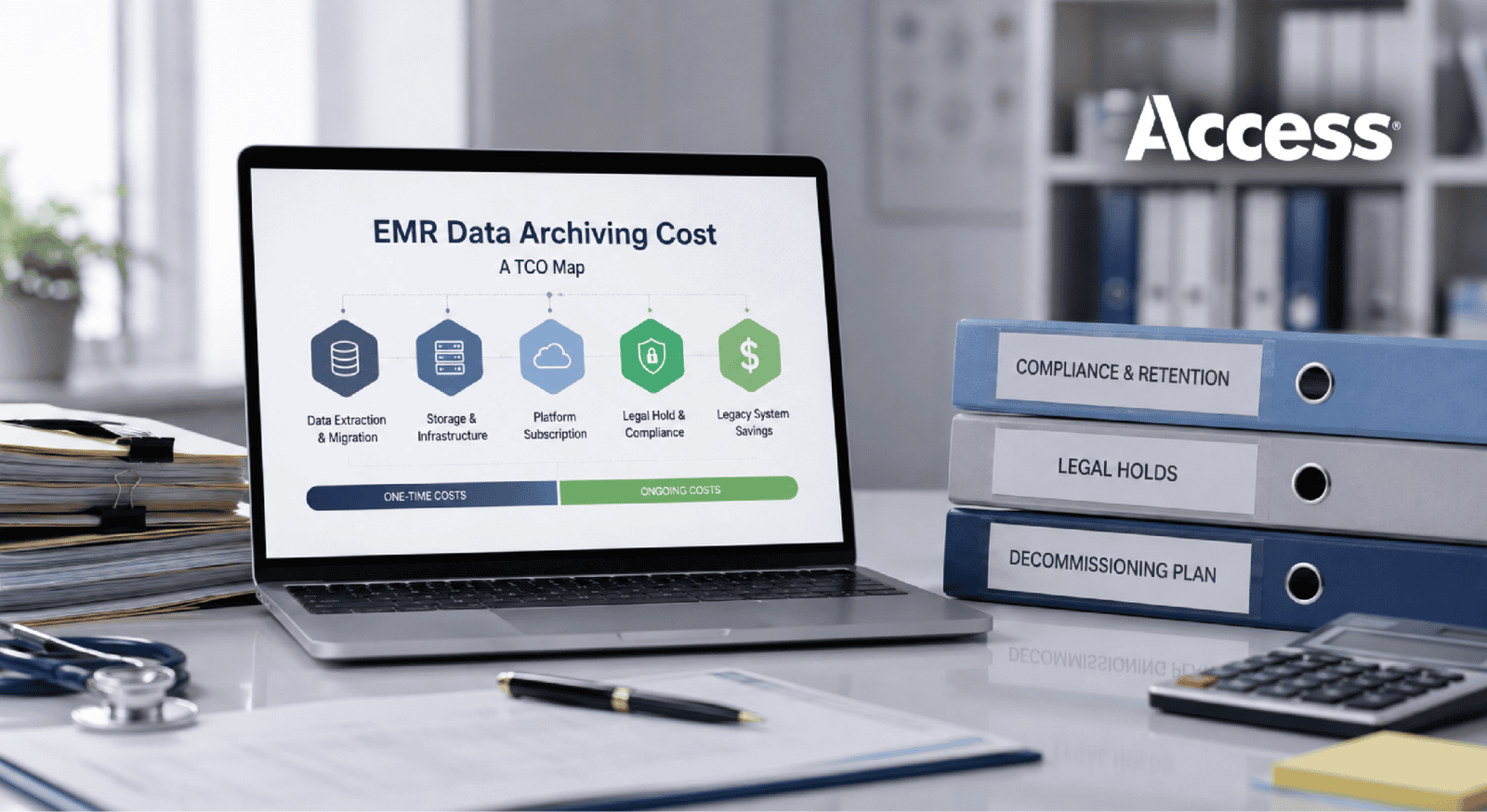
A complete cost model separates one-time and ongoing expenses. One-time costs include data extraction, migration, validation, interface development, and the decommission process itself. Ongoing costs include storage (tiered by access frequency), platform subscription or licensing, support, legal-hold management, and ROI fulfillment.
The right comparison isn’t “archiving cost vs. zero.” It’s “three-year total cost of ownership (TCO) for archiving vs. three-year TCO for keeping the legacy system alive.” When that comparison is run honestly, including legacy licensing, infrastructure, and IT support, archiving typically reaches ROI within 12–18 months. That timeline is supported by the long-term care EHR migration guide.
Broader EHR data management services that bundle migration, hosting, and ongoing support into a managed model can simplify the TCO calculation by converting variable project costs into predictable subscription fees.
The HIPAA Security Rule requires that electronic protected health information (ePHI) be protected for the duration of the applicable retention period. It doesn’t set a specific retention length. That comes from other sources.
CMS Conditions of Participation establish a federal floor of five years for medical records. State laws frequently exceed that floor. Many states require adult records to be retained for ten years, and records for minor patients are often retained until the patient reaches the age of majority plus an additional period. AHIMA maintains guidance on state-by-state variation that HIM directors should consult when mapping retention schedules.
The practical implication: the archive must remain accessible, auditable, and secure for the full retention window. That’s a non-negotiable cost floor, not an optional feature. Failure to produce records on demand, whether in response to a patient request, a litigation hold, or a regulatory audit, carries financial and legal risk that dwarfs the cost of maintaining a compliant archive.
Several factors consistently push archiving costs higher: retiring multiple legacy systems simultaneously, poor source-data quality requiring remediation before migration, custom interfaces or proprietary data formats, compressed decommission timelines, and ongoing legal holds covering large patient populations.
Costs come down when organizations adopt an archive-first strategy before a new EHR go-live, avoiding the dual-system run costs that accumulate when the old system stays live during a parallel period. Tiered storage policies, vendor consolidation across multiple legacy systems, and phased decommissioning with defined milestones all reduce the total bill. The legacy data archival guide for physician groups covers consolidation strategies relevant to multi-site and multi-system environments.
For a broader view of how legacy maintenance costs accumulate and where archiving interrupts that pattern, cut down your cost on legacy EHR maintenance provides useful framing for the business case.
Vendor pricing models vary significantly. Some charge per record, some per gigabyte, some on a flat-fee subscription basis. An RFP should ask vendors to specify their storage tier structure, legal-hold add-on fees, ROI fulfillment SLAs, and how pricing changes as data volume grows over the retention window.
Red flags include opaque pricing that can’t be tied to your specific data footprint, no data-portability guarantee, and contract terms that create lock-in without a clear exit path. Critical factors when selecting a data archival solution outlines the evaluation criteria that matter most for medical records specifically.
Access Unify Health is a purpose-built platform for EHR data archiving that supports structured and unstructured clinical data, legal-hold workflows, and ROI fulfillment within a HIPAA-compliant environment. For organizations in the healthcare information management space evaluating their options, a site-specific assessment against your actual data footprint is the only reliable way to arrive at a real number.
EMR archiving costs are real, but they’re bounded and predictable. Legacy maintenance costs are neither. The business case for archiving rests on a straightforward comparison: a defined, one-time migration investment plus manageable ongoing costs versus an open-ended licensing and infrastructure liability that continues until someone makes a decision.
The path forward is to build a TCO model that captures both sides of that comparison, map your retention obligations under HIPAA and applicable state law, and then evaluate vendors against your specific data footprint. A request a demo conversation is a practical starting point for translating your organization’s data volume and system complexity into a site-specific estimate.
Project length depends primarily on data volume, format complexity, and source-system cooperation. A single legacy EHR with clean structured data can be extracted, validated, and decommissioned in three to six months. Multi-system environments with significant unstructured content, including scanned documents, DICOM imaging, and clinical notes, routinely run nine to eighteen months. Timeline directly affects cost: compressed schedules driven by contract expirations or go-live dates require more parallel work streams and carry higher professional-services fees. A phased decommissioning plan with defined milestones is consistently the lower-cost path. The long-term care EHR migration guide from Access covers phasing strategies in detail.
The comparison needs to capture all costs on both sides over the same time horizon, typically three to five years. For the legacy-system side, that means current licensing fees, infrastructure (servers, hosting, or cloud), IT staff time for patching and support, and any vendor support contract costs. For the archiving side, it means one-time migration and professional-services fees plus ongoing storage, platform subscription, legal-hold management, and ROI fulfillment costs. The legacy side is often underestimated because infrastructure and staff time are treated as sunk costs rather than avoidable ones. EHR data management services that bundle migration and ongoing support into a managed model can simplify this comparison by converting variable project costs into a predictable annual figure.
DICOM imaging files, scanned documents stored as unindexed PDFs, and clinical notes in proprietary vendor formats are the most expensive to extract and transform. Each requires custom extraction logic, and DICOM in particular adds significant storage volume. Before a project begins, organizations can reduce costs by auditing what formats exist in the source system, identifying which records are past their retention window and eligible for defensible deletion, and documenting any system customizations that will affect extraction. Reducing the volume of data that needs to migrate, through a pre-migration records inventory and disposition review, is one of the most effective cost controls available. Critical factors when selecting a data archival solution covers pre-migration assessment criteria in more detail.
Tiered storage assigns data to hot, warm, or cold storage based on how frequently it’s accessed. Hot-tier storage, used for records likely to be retrieved in the near term, carries the highest per-gigabyte cost. Cold-tier storage, used for records that are years past their last access, costs a fraction of that rate. In a healthcare archive, the majority of records become cold-tier candidates within two to three years of the source system being decommissioned, because clinical activity on those records drops sharply once the system is no longer in use. Access has documented storage cost reductions of 50–70% through archival and tiering approaches, as outlined in 6 practical ways data archival reduces healthcare IT costs. The key operational question to ask any vendor is whether tiering is automated by policy or requires manual intervention. Automated tiering is meaningfully more cost-effective over a ten-year retention window.
At minimum, an RFP should require vendors to specify: the storage pricing model (per gigabyte, per record, or flat subscription) and how it changes across tiers; professional-services fee structure for extraction, transformation, and validation; legal-hold add-on fees and whether they’re per-hold, per-record, or included in the base subscription; ROI fulfillment SLAs and whether expedited fulfillment carries additional charges; and how pricing scales as data volume grows over the retention window. Contract terms to scrutinize include data-portability guarantees, exit provisions, and any clauses that tie pricing to the number of concurrent users or facilities. Critical factors when selecting a data archival solution provides a structured evaluation framework for medical records archiving specifically.
Legal holds suspend normal retention and disposition schedules for records that may be relevant to litigation or regulatory investigation. In an archiving context, held records can’t be moved to cold-tier storage or deleted on schedule, which increases storage costs for the duration of the hold. Vendors handle legal-hold pricing differently: some include basic hold functionality in the base subscription, others charge per active hold or per record under hold. Organizations with high litigation volume, including large health systems, organizations in high-liability specialties, or those with significant Medicaid or Medicare populations, should model legal-hold costs as a distinct budget line rather than assuming they’re covered by the base platform fee. The legacy data archival guide for physician groups addresses legal-hold considerations in multi-site environments where hold scope can span multiple legacy systems.
It depends on the vendor model and how similar the source systems are. Consolidating multiple legacy EHRs into a single archive platform typically reduces ongoing costs, with one subscription, one storage environment, and one audit trail, compared to maintaining separate archives or keeping each legacy system alive independently. One-time migration costs for a multi-system project are higher in absolute terms, but the per-system cost often decreases when extraction and validation workflows can be standardized across similar source systems. The primary risk in simultaneous consolidation is project complexity: more systems in parallel means more potential points of failure during validation and reconciliation. A phased approach, prioritizing the highest-cost legacy systems first, manages that risk while still capturing consolidation savings. Access’s healthcare information management capabilities and the legacy data archival guide for physician groups both address multi-system consolidation scenarios.
Retention schedule changes, whether driven by state legislation, updated AHIMA guidance, or federal rule changes, can extend the period for which records must remain accessible. That extension increases ongoing storage and platform subscription costs for affected record classes. A well-structured archive should allow retention schedules to be updated by record type without requiring a full data migration. When evaluating vendors, ask specifically how retention policy changes are implemented: whether they require a professional-services engagement, whether they can be applied retroactively to existing records, and whether the platform maintains an auditable log of policy changes. This is a governance question as much as a cost question. The ability to demonstrate that retention schedules were applied correctly and updated appropriately is part of what makes an archive defensible in a regulatory audit or litigation context. Access’s EHR data archiving platform is designed to support configurable retention policies within a HIPAA-compliant framework.
Related Reading
If you’re working through the TCO comparison between keeping a legacy EHR running and moving to a purpose-built archive, a focused conversation is more useful than a published price list. Request a demo to walk through your data volume, format complexity, and retention obligations with someone who can translate those specifics into a realistic cost picture.



Share